
If you have decided to do something about your legs, the hardest part is not the treatment. It is figuring out who to let near them. Search for a vein specialist in Albuquerque and you will get clinics attached to hospital systems, national chains with a local office, med spas offering cosmetic injections, and independent practices run by one physician. They all use the same words. Minimally invasive. State of the art. Board certified. Nothing in the marketing tells you which one is right for the problem you actually have.
This guide is the checklist a physician would use. What the title vein specialist does and does not guarantee, which credentials carry real weight, why the ultrasound matters more than the laser, the questions worth asking before you book, and the specific signals that should make you keep looking. It applies anywhere, but the local detail is written for Albuquerque and the surrounding metro.
Vein Specialist Is Not a Protected Title
Start here, because almost nothing else makes sense until you understand it. There is no single residency called vein medicine, and in the United States the phrase vein specialist is not restricted. A physician can advertise it after a weekend course on a single device. A physician can also advertise it after a decade of daily venous work. The phrase itself tells you nothing.
Physicians who treat venous disease well arrive from several directions. Interventional nephrology, interventional radiology, vascular medicine, vascular surgery, and cardiology all produce clinicians with deep catheter and ultrasound skill. What they share is not a job title. It is training in image guided work inside blood vessels, and enough case volume in the veins specifically to recognize the uncommon presentations.
So the useful question is never whether someone calls themselves a vein specialist. It is what they are board certified in, how much venous work they personally do, and whether the clinic is set up to diagnose properly before it treats.
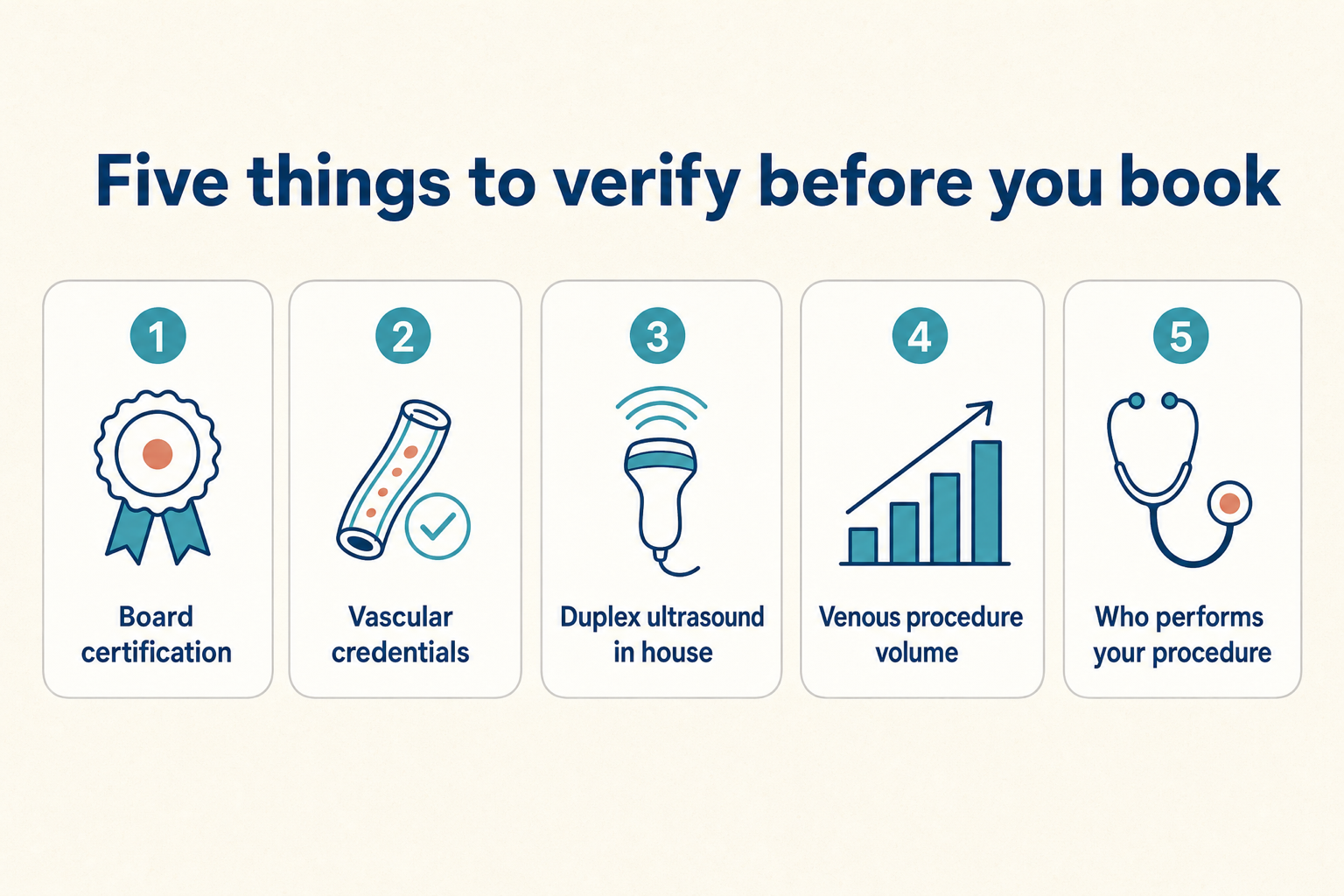
The Five Things Actually Worth Verifying
1. Board certification in a recognized specialty
Board certification means a physician completed an accredited residency or fellowship, passed a rigorous examination, and keeps up with continuing certification requirements. It is verifiable in minutes, because every member board of the American Board of Medical Specialties publishes a public lookup. The National Library of Medicine also maintains a plain language guide to choosing a doctor or health care service that is worth ten minutes before you book anything. If a clinic uses the phrase board certified without naming the board, ask which one.
Be aware that some impressive sounding credentials are self conferred. A certificate from a device manufacturer is training on a product, not a specialty board. Both can appear on the same wall in the same frame.
2. Subspecialty credentials that are specific to vessels
Some certifications are narrow and genuinely hard to get. The American Society of Diagnostic and Interventional Nephrology certifies physicians specifically in endovascular work and dialysis vascular access. The Society for Vascular Medicine is the professional home for physicians whose practice is vascular disease across arteries, veins, and lymphatics. Membership and certification in bodies like these signal that vessels are the center of the practice rather than an add on service.
3. Duplex ultrasound capability, in house, every time
This is the one most people skip and it matters more than any device on the equipment list. Venous disease cannot be diagnosed by looking at the skin. Visible veins are the symptom. The problem is usually incompetent valves in deeper veins that you cannot see, and the only way to find them is a duplex ultrasound that maps blood flow while you are standing.
Ask whether the clinic performs its own venous duplex, whether a credentialed vascular technologist or the physician performs it, and whether you will get a reflux map before a treatment plan. A clinic that proposes a specific procedure before anyone has imaged your legs is guessing.
4. Procedural volume in venous work specifically
Volume is not everything, but in catheter based work it correlates with judgment. Someone who has performed thousands of vascular procedures has seen the anatomy that does not follow the textbook, the vein that is too tortuous for a catheter, the patient whose symptoms do not match the images. Ask roughly how many venous procedures the clinic performs in a year and how many the physician personally performs.
5. Who actually holds the catheter
In some clinics the physician consults and a technician or an advanced practice provider performs the treatment. That is not automatically wrong, but you should know before the day of the procedure, not during it. Ask directly. Who performs my procedure, and will the same physician see me at follow up.
Why the Ultrasound Matters More Than the Laser
Patients tend to shop by device. Radiofrequency versus laser versus medical adhesive versus foam. It is the wrong first question. The device is downstream of the diagnosis, and the diagnosis comes from the ultrasound.
Chronic venous insufficiency happens when the one way valves inside your leg veins stop closing properly, so blood that should travel up toward the heart falls back down and pools. As the National Library of Medicine describes, that sustained pressure is what produces aching, heaviness, swelling, itching, skin changes, and eventually visible bulging veins. The visible vein is the last chapter, not the first.
A proper venous duplex is performed with you standing, because gravity is the thing being tested. The technologist compresses and releases the calf and watches which direction blood moves. Flow that reverses for longer than about half a second is considered significant reflux. That pattern, segment by segment, is your map. It tells the physician which vein is the source, whether the great saphenous or small saphenous system is involved, whether perforating veins are contributing, and whether a deep vein problem is in play that changes the plan entirely.
Only then does the device question make sense. Radiofrequency ablation, endovenous laser, VenaSeal, Varithena, and ultrasound guided sclerotherapy each suit a different anatomy, vein diameter, and symptom pattern. We compare them in detail in our guide to choosing between laser, radiofrequency, VenaSeal, and Varithena. A clinic that offers only one of them will recommend that one, because it is the only tool in the room.
Eleven Questions to Ask Before You Book
- What board are you certified by, and in what specialty? A specific answer should come easily.
- Will I have a venous duplex ultrasound before any treatment is recommended? The answer should be yes, without hesitation.
- Who performs the ultrasound, and who interprets it?
- Which vein segments are refluxing in my legs? After imaging, you should be able to get a plain answer.
- Which treatment options are reasonable for my anatomy, and why this one over the others?
- Who performs the procedure itself?
- How many of these procedures does this clinic do in a year?
- What does recovery look like, realistically, including compression and time off work?
- What happens if my symptoms do not improve, or if a treated vein reopens? A good answer includes follow up imaging.
- Is this treatment likely to be covered by my insurance, and who handles the authorization?
- What are the risks specific to me? Every venous procedure carries some risk of bruising, nerve irritation, pigmentation, or clot. A clinic that lists none is not being straight with you.
Red Flags
- A treatment plan before an ultrasound. The single clearest signal to walk.
- Everything framed as cosmetic. Spider veins can be purely cosmetic. Aching, swelling, night cramps, restless legs, itching, and skin discoloration are medical. A clinic that treats all of it as a beauty service may miss underlying disease. If the only thing being measured is appearance, keep looking.
- One device for every patient.
- Pressure to pay or sign the same day. Venous disease is chronic and progressive, not an emergency. There is time to think.
- Before and after photographs as the only evidence offered. Ask about symptom outcomes, closure rates, and follow up imaging instead.
- No physician in the building.
- Vague ownership of the insurance process. If nobody can tell you who submits the authorization, you will end up doing it yourself.
- Promises. Any clinic guaranteeing a result, or using the language of a permanent cure, is making a claim medicine cannot support. Individual results vary, and an honest practice says so.
The Insurance Question, Briefly
Most insurers draw a line between medically necessary venous treatment and cosmetic treatment. Treatment of symptomatic venous insufficiency documented on ultrasound is frequently covered. Treatment of spider veins for appearance alone generally is not. Many plans also require a documented trial of conservative measures such as graduated compression stockings, elevation, and exercise before they will authorize a procedure.
This is another reason the ultrasound comes first. The imaging is what creates the documentation an insurer needs. A clinic experienced with venous authorization will know your plan’s requirements, start the clock on any conservative therapy period early, and tell you what your exposure looks like before you commit. We go through the details in our guide to vein treatment cost and insurance coverage.
What a Thorough First Visit Should Include
A complete initial evaluation has a recognizable shape. A symptom history that asks about more than appearance, including heaviness, aching, night cramps, restlessness, itching and burning, and swelling patterns through the day. A standing examination of both legs. A venous duplex with reflux mapping. A clinical severity assessment. A conversation about conservative measures. Then a treatment discussion that names your options rather than one option.
You should leave knowing which veins are the problem, what the realistic range of outcomes is, and what the next step costs. If you leave with only a quote, the visit was incomplete. Our walkthrough of what to expect at a first vein appointment covers the sequence in more detail, and how vein treatment works explains what happens inside the vein.
Choosing in Albuquerque Specifically
Two practical local factors are worth weighing. The first is continuity. Venous treatment is rarely one appointment. It is a consultation, an ultrasound, often a compression trial, a procedure, and at least one follow up with repeat imaging. A clinic twenty minutes away that you will actually return to beats a slightly cheaper option you stop going to. Patients across the metro, including Rio Rancho, Bernalillo, Corrales, and Los Lunas, are within a straightforward drive of the Osuna Road corridor.
The second is breadth of diagnosis. Leg symptoms in New Mexico are not always venous. Heat, elevation, and dry air make leg complaints common, and deep vein thrombosis, lymphedema, May-Thurner syndrome, arterial disease, and musculoskeletal causes all mimic venous disease to some degree. A clinic that can only see veins will find veins. One that evaluates the whole vascular picture is more likely to tell you when your legs are not actually a vein problem, which is a genuinely useful answer.
Frequently Asked Questions
What kind of doctor should I see for varicose veins?
See a physician who is board certified in a recognized specialty that involves image guided work inside blood vessels, who performs venous duplex ultrasound before recommending treatment, and who personally performs a meaningful volume of venous procedures. Interventional nephrology, interventional radiology, vascular medicine, vascular surgery, and cardiology all produce physicians who do this work well. The specialty name matters less than the certification, the imaging, and the volume.
Is vein specialist a real medical specialty?
No. It is a descriptive phrase, not a protected or regulated title, and it carries no training requirement on its own. That is why verifying board certification and asking who performs your ultrasound and your procedure is more informative than the label on the door.
How do I verify a physician’s board certification?
Each American Board of Medical Specialties member board maintains a free public lookup where you can confirm a physician’s certification status and the year it was granted. Search for the specific board, for example the American Board of Internal Medicine for internal medicine and its subspecialties. You can also ask the clinic directly which board certified the physician and in what year. A straightforward practice answers that without friction.
Do I need a referral to see a vein specialist in Albuquerque?
It depends on your plan. Many PPO plans allow you to schedule directly, while HMO and some Medicare Advantage plans require a referral from your primary care physician. Call the clinic before you book and ask them to check. An experienced office will verify your benefits and tell you what your plan requires.
Should I get a second opinion on a vein treatment plan?
If the plan was proposed without an ultrasound, if only one treatment option was presented, or if you felt rushed, yes. Venous insufficiency is chronic and progressive rather than urgent, so there is almost always time for a second evaluation. Ask for a copy of your duplex report and images so the second clinic is not starting from zero.
Is a vein clinic the same as a med spa that treats veins?
Not usually. Many med spas offer cosmetic injection of surface spider veins without diagnostic ultrasound or physician evaluation of the deeper system. For purely cosmetic surface veins in someone with no symptoms, that can be reasonable. If you have aching, swelling, heaviness, cramping, itching, or skin changes, those symptoms warrant a medical evaluation first, because treating the surface while leaving an underlying source untreated commonly leads to the veins returning.
How long should a first vein consultation take?
Plan on roughly an hour. A symptom history, a standing examination of both legs, a venous duplex with reflux mapping, and a treatment discussion do not compress into fifteen minutes. If the appointment is much shorter than that, ask what part was left out.
Vein Care in Albuquerque
Advanced Vascular is an independent practice on Osuna Road in Albuquerque, serving patients from across the metro and the wider state. Dr. Satyaki Banerjee is a board-certified interventional nephrologist, certified by the American Society of Diagnostic and Interventional Nephrology, with thousands of vascular procedures performed. Every patient gets the same sequence. Listen first. Image carefully. Recommend only what the imaging and the symptoms support.
That includes telling people when a procedure is not the right next step. Sometimes the honest recommendation is compression and a recheck in three months. You will get that answer here if that is the answer.
To arrange an evaluation, schedule an appointment or contact our office at (505) 814-0318. The clinic is at 4501 Osuna Road NE, Suite 1, Albuquerque, NM 87109, with easy parking.
This article is for general education and does not replace a medical evaluation. Individual results vary, and whether any treatment is appropriate for you can only be determined after an in person examination and imaging. If you have sudden leg swelling, severe pain, redness and warmth in one leg, chest pain, or shortness of breath, seek emergency care now.