
You have already accepted that the bulging vein on your calf is not going to resolve on its own. You have worn the compression stockings, elevated your legs, and heard the words “we can treat that.” Then a website lists four procedure names, and you are left choosing between laser, radiofrequency, VenaSeal, and Varithena with no idea what separates them.
Here is the honest answer most clinics skip. All four close a diseased vein and reroute blood into healthy veins nearby, and all four are performed in the office in about an hour. The differences that actually matter to you are how the vein is closed, how much numbing medicine is involved, whether you wear compression stockings afterward, and how well each option handles the specific shape and depth of your vein. That last factor is the one patients almost never consider, and it is usually the one that decides the plan.
This guide walks through each option the way we discuss it during a consultation at Advanced Vascular in Albuquerque, so you arrive already knowing the questions worth asking.
Vein Ablation Replaced Vein Stripping, and That Changed the Entire Decision
Thirty years ago, treating a failing great saphenous vein meant a hospital admission, general anesthesia, and physically pulling the vein out of the leg through incisions at the groin and knee. Today that procedure is largely historical. Every treatment described below is performed through a single needle puncture, under local anesthesia, with you awake and walking out of the office the same day.
The underlying problem is the same in all cases. Veins in the leg carry blood upward against gravity using one way valves. When those valves fail, blood flows backward and pools, a condition called venous reflux or chronic venous insufficiency. The pressure that builds up produces the aching, heaviness, swelling, itching, and visible bulging that brought you here. The National Heart, Lung, and Blood Institute describes this valve failure as the central mechanism behind varicose veins.
Ablation does not remove the vein. It closes it permanently, and your body reroutes that blood through healthy deep veins that were already carrying the majority of the load. Understanding that closing a vein is the goal makes the four options much easier to compare, because they are simply four different ways of sealing the same tube. If you want the broader picture first, our overview of how vein treatment works covers the diagnostic path that leads here.
Radiofrequency Ablation Closes the Vein With Controlled, Measured Heat
A patient with a straight, moderately enlarged great saphenous vein running down the inner thigh is the classic radiofrequency candidate, and this is the most commonly performed vein ablation in the United States.
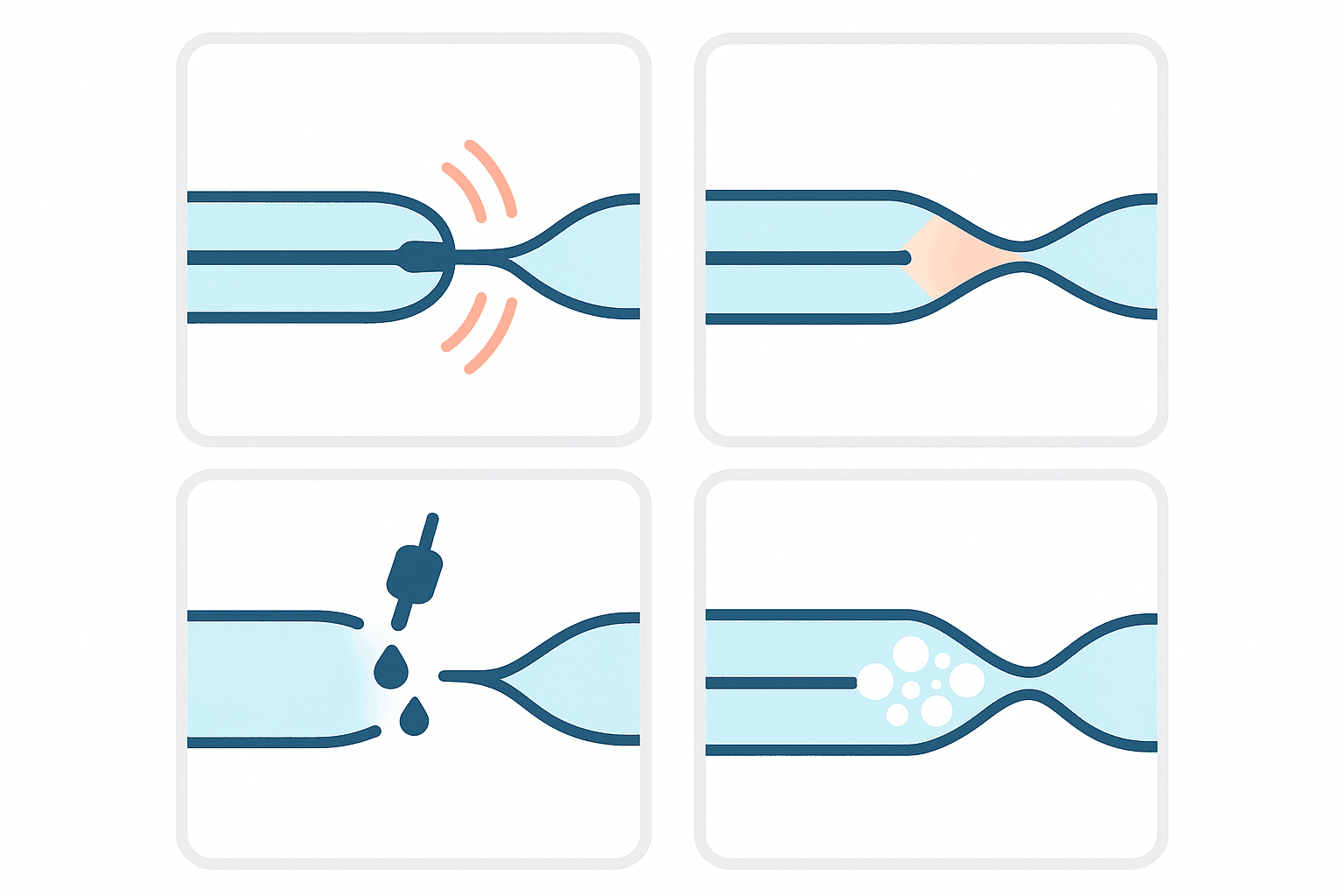
How it works. Under ultrasound guidance, a thin catheter is threaded into the diseased vein through a needle puncture near the knee or calf. The catheter tip heats the vein wall in measured segments of about seven centimeters at a time, holding a controlled temperature near 120 degrees Celsius. The heat causes the collagen in the vein wall to contract and seal shut. Radiofrequency ablation is precise because the temperature is regulated rather than delivered as a burst of energy.
What the appointment is like. Expect roughly forty five to sixty minutes in the office. Before the catheter is activated, a dilute anesthetic solution is injected along the length of the vein using ultrasound guidance. This numbs the vein and also cushions the surrounding tissue from the heat. Those injections are the part patients describe as the least comfortable, and they take a few minutes. The ablation itself is usually felt as pressure or mild warmth, not pain.
Recovery. Most patients walk immediately after and return to desk work the next day. Bruising and a pulling or tight sensation along the treated vein are common for one to two weeks. Strenuous lifting and hot tubs are typically restricted for about a week.
Compression afterward. Yes. Graduated compression stockings are typically worn for one to two weeks, and our specific recommendation depends on the extent of treatment.
Honest limitations. Because a rigid catheter has to advance through the vein, radiofrequency works best in relatively straight segments. Heavily twisted veins are difficult or impossible to navigate. The tumescent anesthesia step also means more needle sticks than the adhesive option. Our earlier article on how radiofrequency ablation treats chronic venous insufficiency goes deeper on the mechanism if that is what you want next.
Endovenous Laser Ablation Uses Light Energy Rather Than Radiofrequency Waves
If your vein is unusually large in diameter, laser is often the option raised first, because laser fibers deliver higher energy density and handle bigger veins reliably.
How it works. Endovenous laser ablation, also written as EVLA or EVLT, follows the same path as radiofrequency. A fiber rather than a heating element is passed into the vein under ultrasound guidance. Laser light is absorbed by the blood and vein wall, generating heat that seals the vein. Modern radial tipped fibers emit energy sideways in a full circle instead of straight ahead, which distributes heat more evenly and has meaningfully improved comfort compared with older bare tip lasers.
What the appointment is like. Nearly identical to radiofrequency. Same single puncture, same tumescent anesthesia step, same roughly hour long visit, same walk out afterward.
Recovery. Comparable to radiofrequency. Published comparisons generally show slightly more bruising and post procedure soreness with laser, particularly with older fiber designs, though closure rates between the two are similar and both are well supported in the literature. The Society for Vascular Surgery lists both thermal ablation methods among the standard treatments for symptomatic varicose veins.
Compression afterward. Yes, on a similar one to two week schedule.
Honest limitations. Same navigational constraint as radiofrequency, since a fiber still has to travel the length of the vein. The bruising tendency is real, and patients who bruise easily should raise it during consultation.
VenaSeal Closes the Vein With a Medical Adhesive and No Heat at All
Consider the patient who works on their feet in Rio Rancho, cannot take a week of modified activity, and genuinely does not want to wear compression stockings through an Albuquerque July. That patient is the reason the adhesive option exists.
How it works. VenaSeal uses a proprietary medical grade cyanoacrylate adhesive. A catheter delivers small precise amounts of adhesive along the vein while gentle pressure is applied from outside. The vein walls are pressed together and bonded, and the body gradually absorbs the closed vein over time. No heat is generated, which is the defining difference.
What the appointment is like. Shorter and involving far fewer needles. Because there is no heat, the tumescent anesthesia step is unnecessary. A single injection of local anesthetic at the access site is generally all that is required. Many patients describe this as the most comfortable of the four.
Recovery. The fastest of the group. Most patients resume normal activity the same day with minimal restrictions.
Compression afterward. Usually not required, which is the feature patients most often ask about by name. Your specialist may still recommend stockings in certain cases, particularly with significant swelling or if additional treatments are performed at the same visit.
Honest limitations. Two matter. First, a small percentage of patients develop a hypersensitivity reaction to the adhesive, producing a localized inflamed area along the vein that resolves but can be uncomfortable, so a known cyanoacrylate allergy rules it out. Second, insurance coverage for VenaSeal is less consistent than for thermal ablation, and some plans still classify it differently. We verify your specific benefits before scheduling.
Varithena Reaches Twisted Veins That No Catheter Can Follow
Some patients arrive after being told at another clinic that their veins are “not treatable” because a catheter would not pass. That is frequently a Varithena situation.
How it works. Varithena is an FDA approved polidocanol injectable foam. Because it is a foam rather than a device, it does not need a straight path. It fills the vein, displaces blood, and contacts the vein wall directly, causing the vein to collapse and close. This makes it uniquely suited to tortuous veins, veins above and below the knee in one treatment, and veins that have recurred after prior treatment.
What the appointment is like. Typically the shortest visit of the four. The foam is injected through a small catheter or needle under ultrasound guidance. No tumescent anesthesia is needed. Many patients are in and out in under an hour.
Recovery. Walking is encouraged immediately and is actually part of the aftercare, because movement keeps the deep veins flowing. Most patients return to routine activity quickly, with vigorous exercise restricted for about a week.
Compression afterward. Yes, and this is the one where compression matters most. Stockings or wraps are typically worn continuously for around two weeks to help the treated vein stay closed.
Honest limitations. Larger or more extensive veins sometimes require more than one session. Temporary skin discoloration along the treated vein and small areas of trapped blood that need drainage at a follow up visit are both known and manageable outcomes.
Ultrasound Guided Sclerotherapy Handles the Smaller Tributaries Left Behind
Closing the great saphenous vein does not always resolve every visible bulge. Smaller feeder veins branching off the main trunk often remain, and those are treated separately.
Ultrasound guided sclerotherapy injects a liquid or foam sclerosant into veins that sit too deep to see but are too small for a catheter. Ultrasound lets us place the needle precisely. Sessions are brief, compression is typically worn for one to two weeks, and more than one session is common. This is a companion procedure rather than a competitor to ablation, and it is distinct from surface spider vein treatment, which addresses cosmetic vessels visible at the skin.
Side by Side Comparison of the Four Ablation Options
Use this as a conversation starter, not a decision. The right choice comes out of your duplex ultrasound, not a table.
| Treatment | Mechanism | Anesthesia needed | Typical recovery | Compression after | Best suited for |
|---|---|---|---|---|---|
| Radiofrequency ablation | Controlled thermal energy seals the vein wall | Local plus tumescent along the vein | Back to desk work next day, bruising 1 to 2 weeks | Typically 1 to 2 weeks | Straight great or small saphenous veins of moderate size |
| Endovenous laser ablation | Laser light energy seals the vein wall | Local plus tumescent along the vein | Similar to radiofrequency, slightly more bruising | Typically 1 to 2 weeks | Larger diameter straight truncal veins |
| VenaSeal | Medical adhesive bonds the vein walls together, no heat | Single local injection at access site | Usually same day return to normal activity | Often not required | Patients avoiding stockings or needing minimal downtime |
| Varithena | Polidocanol foam contacts the vein wall and collapses it | Local at injection site only | Walking encouraged immediately, light activity about a week | Yes, typically about 2 weeks | Twisted, tortuous, recurrent, or below knee veins |
Why Your Vein Anatomy Decides the Treatment, Not Your Preference
Two patients can walk in with identical looking legs and leave with different treatment plans. The reason is that a duplex ultrasound reveals things the eye cannot.
Five anatomical factors drive the recommendation:
- Which vein is failing. The great saphenous vein runs along the inner leg from ankle to groin. The small saphenous vein runs up the back of the calf and sits close to the sural nerve, which makes thermal energy near it a more careful proposition. Accessory and tributary veins behave differently again.
- Diameter. Very large veins favor higher energy approaches. Very small veins may not accept a catheter at all.
- Tortuosity. This is the twisting of the vein along its course. A rigid catheter cannot round tight corners, so a highly tortuous vein points toward foam.
- Depth and proximity to structures. Veins sitting very close to the skin risk heat related skin injury or discoloration with thermal methods. Veins near nerves raise the same caution.
- Prior treatment. Recurrent veins after previous ablation often have irregular scarred anatomy that foam navigates more easily than a device.
This is why no reputable clinic quotes a procedure before scanning your legs. Mayo Clinic’s overview of varicose vein diagnosis and treatment makes the same point. Ultrasound comes first, and suitability for any given option is determined at consultation based on your individual anatomy and medical history.
What Insurance Covers in New Mexico and What It Requires First
A patient once delayed treatment two years assuming vein work was cosmetic and out of pocket. It usually is not.
When varicose veins cause documented symptoms such as aching, heaviness, swelling, skin changes, or ulceration, and a duplex ultrasound confirms venous reflux, endovenous ablation is generally treated as a medically necessary procedure and covered by most major plans and by Medicare. Purely cosmetic treatment of surface spider veins is generally not covered.
Most plans require documentation before authorizing treatment:
- A duplex ultrasound confirming valve failure, often with reflux time above a defined threshold
- Documented symptoms affecting daily function
- A trial of conservative therapy, commonly six to twelve weeks of graduated compression stockings
That conservative therapy requirement is why timing matters. A patient who starts documented compression therapy in July is typically cleared for treatment in the autumn. Our guide to vein treatment cost and insurance coverage breaks the process down further. Coverage varies by plan, and we verify your specific benefits before anything is scheduled.
What Recovery Actually Looks Like, Week by Week
Patients consistently report that recovery was easier than expected and that the cosmetic result took longer than expected. Both are normal.
Day of treatment. You walk out and walk regularly at home. Driving is generally fine unless sedation was used. Compression begins if prescribed.
Days one to seven. Most people are back to normal daily routine and desk work within a day. Expect bruising along the treated vein with thermal methods and a tight or pulling sensation. Heavy lifting, running, and hot tubs are typically paused.
Weeks two to four. Bruising fades. A firm cord along the treated vein is normal and softens over time. A follow up ultrasound confirms the vein closed properly.
Months two to six. Symptom relief such as reduced aching and swelling often arrives within weeks, while the visible appearance continues improving for several months as the closed vein is absorbed. Additional sessions for tributaries or spider veins are frequently scheduled during this window.
Ablation can reduce symptoms and improve appearance substantially in most patients, but it does not stop new veins from developing elsewhere over time. Ongoing compression use, movement, and periodic follow up help manage that risk.
Vein Care for Albuquerque, Rio Rancho, Corrales, Bernalillo, Los Ranchos, and Los Lunas
Albuquerque’s July highs sit in the low nineties, and heat causes blood vessels to dilate. In legs with failing valves, that dilation makes pooling worse, which is why so many patients notice their symptoms peak in midsummer. The dry high desert air compounds it through dehydration.
Advanced Vascular treats patients from across the metro, including Rio Rancho, Corrales, Bernalillo, Los Ranchos de Albuquerque, and Los Lunas. All four ablation procedures are performed in our outpatient office. There is no hospital stay and no general anesthesia. Patients traveling from our Rio Rancho service area and the surrounding communities are typically home within a couple of hours of arriving.
Dr. Satyaki Banerjee is a board-certified interventionist and ASDIN-certified vascular access specialist who performs these procedures using ultrasound guidance in the office.
Frequently Asked Questions
What is the difference between laser and radiofrequency vein ablation?
Both use heat delivered through a catheter to seal a diseased vein, and both require numbing medicine injected along the vein. Radiofrequency holds a regulated temperature in measured segments, while laser delivers light energy absorbed by the vein wall. Closure rates are comparable. Laser is often favored for very large veins, and radiofrequency is often associated with slightly less bruising.
Which varicose vein treatment has the shortest recovery time?
VenaSeal generally has the shortest recovery, because no heat is used, no tumescent anesthesia is required, and compression stockings are often unnecessary. Most patients return to normal activity the same day. Suitability still depends on your anatomy and your insurance coverage.
Does vein ablation hurt?
Most patients describe mild discomfort rather than pain. With thermal treatments, the numbing injections along the vein are the least comfortable part and last a few minutes. The ablation itself is usually felt as pressure or warmth. VenaSeal and Varithena involve fewer injections.
How long do I have to wear compression stockings after treatment?
After radiofrequency or laser ablation, typically one to two weeks. After Varithena, typically around two weeks of more consistent wear. After VenaSeal, compression is often not required at all. Your specialist sets the exact schedule based on what was treated.
Will my varicose veins come back after ablation?
A properly closed vein does not reopen in the large majority of cases, and long term closure rates for these procedures are high. However, vein disease is progressive, and new varicose veins can develop in other veins over the years. Follow up visits, compression use, and staying active help manage that.
Is vein ablation covered by insurance in New Mexico?
Usually yes, when the veins cause documented symptoms, a duplex ultrasound confirms venous reflux, and you have completed the conservative therapy trial your plan requires, commonly six to twelve weeks of compression. Purely cosmetic treatment is generally not covered. We verify your specific benefits before scheduling.
How soon can I return to work after a vein ablation procedure?
Most patients with desk based work return the next day, and many return the same day after VenaSeal or Varithena. Physically demanding jobs involving heavy lifting usually warrant a few days of modified duty. We give you a specific timeline based on the procedure and your work.
Do I need general anesthesia for vein ablation?
No. All four procedures are performed with local anesthesia while you are awake. There is no hospital admission and no breathing tube. You walk out of the office afterward.
Schedule a Free Consultation in Albuquerque
You cannot choose between these four options from a webpage, and you should not have to. The decision is made after a duplex ultrasound shows exactly which veins are failing, how large they are, how they run, and how close they sit to skin and nerve.
Advanced Vascular offers a free consultation for patients across Albuquerque and the surrounding metro. We scan your legs, explain what we find in plain language, tell you which options your anatomy actually supports, and walk you through what your insurance will require. Schedule your free consultation or learn more about varicose vein treatment at our Albuquerque office.
This article is for general educational purposes and is not a substitute for individual medical advice. Treatment suitability is determined at consultation based on your examination, ultrasound findings, and medical history.