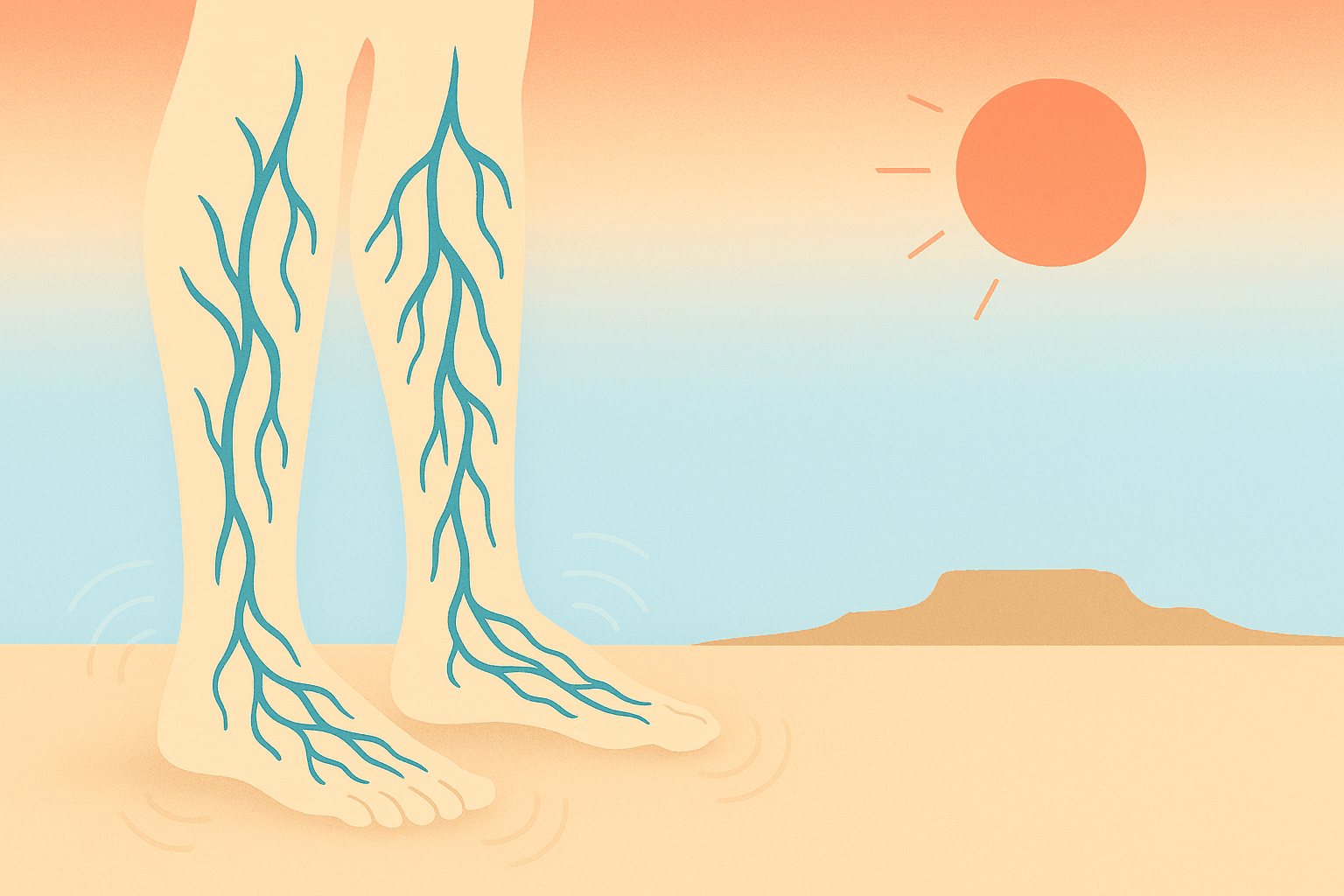
Your legs start to prickle about ten minutes into a walk. By the time you get back to the car, the skin below your knees feels hot, tight, and itchy enough that you want to scratch through your jeans. You put lotion on it. It helps for an hour. Then it comes back.
If that sounds familiar, and if it has been getting noticeably worse since the Albuquerque heat set in, there is a good chance the problem is not your skin at all. It is what is happening underneath it, in the veins that are supposed to be carrying blood out of your legs and back toward your heart.
Most people never make that connection. They treat itchy, burning legs as a moisturizer problem for years before anyone tells them it can be a circulation problem. This article explains the mechanism, the seasonal pattern that gives it away, the warning signs that mean you should be evaluated, and what a vein specialist can actually do about it.
What Itchy, Burning Legs Actually Feel Like, and Why It Is Rarely Just Dry Skin
Patients who come in for this almost never use the word “itchy” first. They say their legs feel hot. They say the skin feels tight, or like it is stretched. They describe a crawling or prickling sensation that shows up in the lower third of the leg, usually around the ankle and the inner calf, and that gets aggressive after standing at work or walking through a parking lot.
A few details separate this from ordinary dry skin:
- Location. Venous itching concentrates below the knee, especially around the inner ankle. Dry skin itches everywhere, including your arms and back.
- Timing. It flares with standing, walking, heat, and the end of the day. Dry skin does not care what time it is.
- Appearance. The skin may look shiny, reddish brown, or slightly discolored around the ankle. There may be visible veins nearby, or there may not be.
- Response to moisturizer. Lotion gives short relief and then stops working. If moisturizer solved it, it was probably dry skin.
- Swelling. Sock lines that stay pressed into the ankle at the end of the day are a strong clue.
That last point matters more than most people realize. Swelling and itching travel together in venous disease because they share a cause: fluid leaking out of overloaded veins into the surrounding tissue.
Why Albuquerque’s Summer Heat Makes Leg Itching and Burning Worse
Albuquerque’s normal July high runs 91 to 93 degrees. That number matters clinically, not just for comfort.
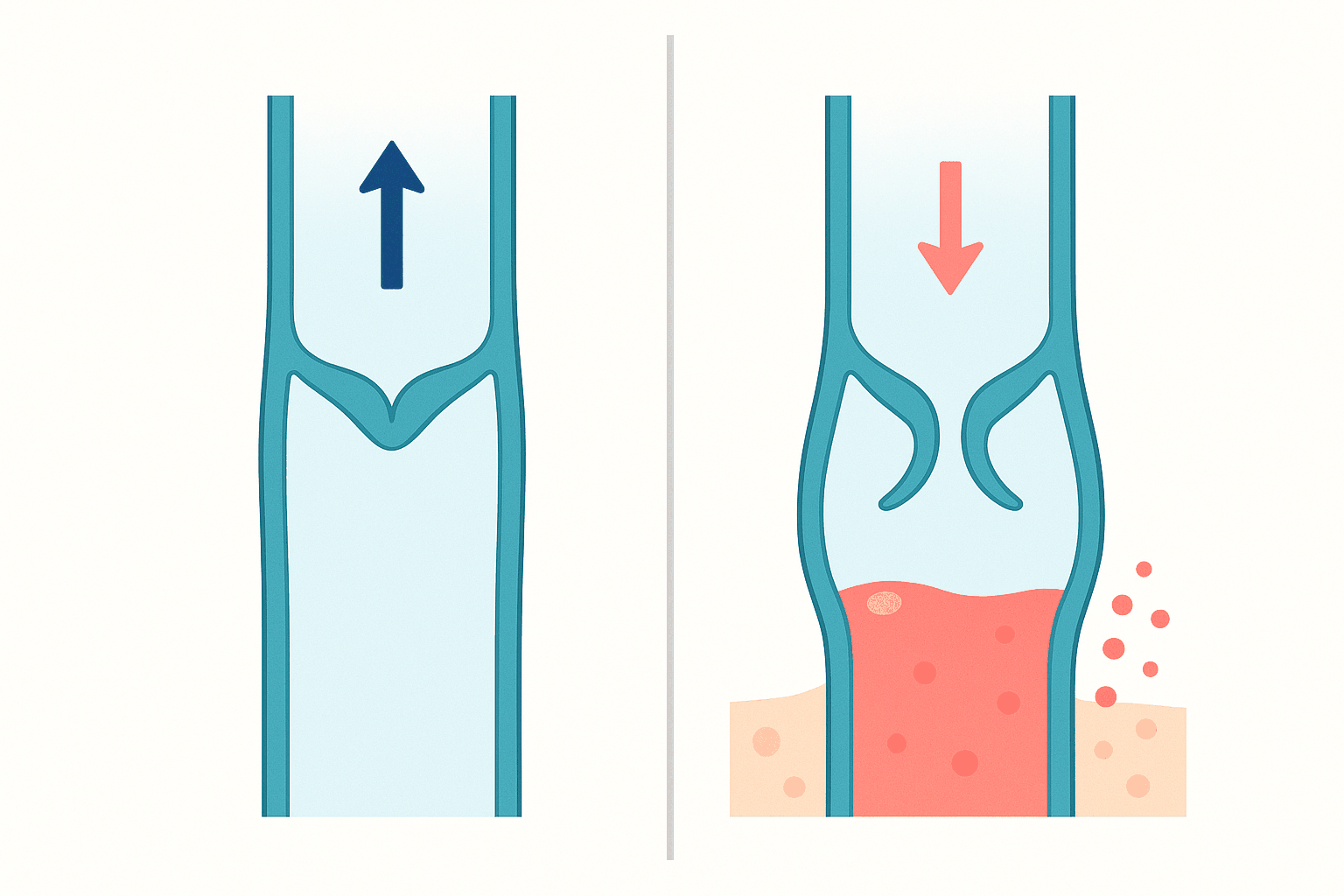
When your core temperature rises, your body dumps heat by widening the blood vessels near the skin. That is vasodilation, and it is a healthy reflex. In a leg with normal vein valves, the widened veins still move blood upward efficiently and nothing goes wrong.
In a leg where those one way valves have failed, vasodilation makes an existing problem measurably worse. The vein walls expand, the already leaky valves separate further, and more blood falls backward and pools in the lower leg. Pressure inside the vein rises. Fluid and inflammatory mediators get pushed out through the vessel wall into the skin. Many vein practices identify roughly 90 degrees as the point where patients start reporting a clear jump in aching, heaviness, swelling, and itching. Albuquerque sits above that line for most of July.
The high desert adds a second mechanism. Low humidity pulls water out of you fast, often without the obvious sweat that would warn you. Mild dehydration thickens the blood and slows venous return, which stacks on top of the vasodilation effect. It also dries the skin barrier, so an already inflamed leg gets a second insult on the surface.
This is why so many patients book a consultation in July after ignoring the symptom since March. The heat did not create the vein problem. It exposed it.
The Vein Connection: How Poor Circulation Irritates the Skin
Leg veins carry blood uphill against gravity. They do it with a series of one way valves and with the pumping action of your calf muscles. When those valves stop closing properly, blood refluxes downward and collects in the lower leg. That condition is called venous reflux, and when it becomes persistent it is called chronic venous insufficiency. The National Heart, Lung, and Blood Institute maintains a plain language overview of chronic venous insufficiency that is worth reading alongside this.
Here is the part that connects veins to itching. Sustained high pressure inside the small veins of the lower leg forces plasma, proteins, and white blood cells out through the capillary walls into the surrounding tissue. The immune system reads that leaked material as a problem and mounts a low grade inflammatory response in the skin. Mast cells in the dermis release histamine. Histamine is the same chemical that makes a mosquito bite itch.
So the itch is real, it is chemically driven, and it originates several layers below where you are scratching. That is exactly why topical treatment underperforms. You are treating the surface of a problem whose engine is the pressure inside the vein.
Over time this process has a name and a visible appearance. It is called venous eczema, or venous stasis dermatitis, and it produces the reddish brown staining, scaling, and thickened skin that shows up around the ankles of people who have had untreated reflux for years.
Why you can have vein disease without visible varicose veins
This trips up a lot of patients. Bulging, rope like varicose veins are the obvious sign of venous disease, but they are not required for a diagnosis. Reflux frequently occurs in the great saphenous vein, which runs deep enough that you cannot see it from the outside. Plenty of people with significant reflux have cosmetically normal looking legs and a lot of symptoms. Some have nothing visible except a cluster of spider veins near the ankle, which is often the first surface hint of deeper pressure.
The only reliable way to know is imaging, not inspection.
Why It Gets Worse When You Walk, Stand, or Lie Down at Night
The single most useful diagnostic clue in this whole picture is the pattern. Venous symptoms follow gravity and blood volume in a way that dry skin and nerve problems do not.
When you stand still, the calf muscle pump shuts off. Blood pools immediately. Pressure in the lower leg veins climbs toward its maximum. This is why symptoms peak in cashiers, nurses, teachers, hairdressers, and anyone who spends a shift on their feet without walking much.
When you walk, blood flow to the legs increases substantially to feed working muscle. In a healthy leg the calf pump handles the extra volume. In a refluxing leg the pump pushes blood up and the failed valves let much of it fall right back down, so the lower leg receives more blood than it can clear. Pressure and warmth build together, and the itching and burning arrive a few minutes into the walk. This is the mechanism behind the very common complaint of legs that itch and burn when walking.
At night, two things happen. You finally lie down, so fluid that spent the day in your tissue starts reabsorbing, and the skin rewarms under blankets. Rewarming amplifies histamine driven itch. Nighttime is also when there is nothing else competing for your attention, so a symptom you managed to ignore all day becomes the only thing you can think about.
What this pattern rules out
Peripheral neuropathy, which is the other common cause of burning legs, tends to behave differently. It is often symmetric, frequently involves the feet and toes first, causes numbness and pins and needles rather than true itch, and does not reliably improve when you elevate the leg. Arterial disease produces cramping pain in the calf with walking that resolves within a few minutes of stopping, and it does not itch.
The single best home test for a venous cause: lie down and elevate your legs above heart level for fifteen minutes. If the burning and itching noticeably settle, gravity was driving it, and that points at your veins.
Warning Signs That This Is More Than a Skin Problem
Get evaluated by a vein specialist if you have any of the following, and get evaluated promptly if you have more than one:
- Itching or burning concentrated around the ankles and lower calves that recurs for more than a few weeks
- Ankle swelling that is worse at the end of the day and better in the morning
- Brown, rust colored, or purplish discoloration of the skin above the ankle
- Skin that has become shiny, hardened, leathery, or tight to the touch
- Weeping, crusting, or scaling patches of skin on the lower leg
- An open sore near the ankle that has not healed in two weeks
- Visible varicose veins along with any of the above
- A heavy, aching, or restless feeling in the legs that worsens through the day
An open, non healing sore near the ankle deserves immediate attention. That is a venous ulcer, and it is the end stage of the same process that started as an itch. Ulcers are far easier to prevent than to heal.
Separately, if one leg becomes suddenly swollen, warm, red, and painful over hours to a day, that is not a vein irritation question. That is a possible deep vein thrombosis, and it needs same day medical evaluation.
What Happens If You Ignore It: From Itching to Dermatitis to Ulcers
Venous disease is progressive. It does not plateau on its own, and the sequence is well documented in the medical literature. The Society for Vascular Surgery outlines the same staged progression.
It typically runs like this. Aching and heaviness come first, often dismissed as tiredness. Then swelling that resolves overnight. Then itching and burning as inflammatory mediators reach the skin. Then discoloration and stasis dermatitis as iron from broken down red blood cells stains the tissue. Then lipodermatosclerosis, where the skin and fat of the lower leg harden and the ankle takes on a narrowed, inverted bottle shape. Then ulceration, usually triggered by a minor bump that will not heal.
The timeline varies enormously between patients. Some move through it in three years, others in twenty. What is consistent is the direction. Treating reflux early, while the problem is still an itch, is considerably simpler than managing an ulcer that has been open for eight months.
What You Can Do at Home This Summer, and Where Self-Care Runs Out
These measures genuinely help symptoms, and most patients should be doing them regardless of whether they pursue treatment.
- Graduated compression stockings. The most effective non procedural option by a wide margin. Knee high, 20 to 30 mmHg for most symptomatic patients. Put them on before you get out of bed, when swelling is at its lowest.
- Elevate above heart level. Fifteen to twenty minutes, two or three times a day. Legs on the couch arm, not just on an ottoman.
- Walk deliberately. The calf pump only works when the calf works. Walking beats standing, and standing beats sitting still.
- Hydrate for the desert. Albuquerque’s dry heat dehydrates you faster than the temperature suggests.
- Cool the skin. A cool shower or a cool cloth reduces histamine driven itch better than heat does. Hot showers feel good for thirty seconds and make it worse afterward.
- Fragrance free emollient. Supports a damaged skin barrier and reduces cracking, even though it does not address the cause.
- Do not scratch. Scratching breaks skin that already heals poorly and is a common first step toward an ulcer.
Here is the honest limit. None of this repairs a failed valve. Compression manages pressure while you are wearing it, and the pressure returns the moment you take it off. Antihistamines blunt the itch signal without touching the reflux generating it. Steroid creams calm surface inflammation and, used for long stretches, thin skin that is already fragile. Self-care buys comfort and slows progression. It does not reverse the underlying condition.
Worth knowing: most insurers require a documented trial of conservative therapy, commonly six to twelve weeks of compression, before they will authorize a procedure. Starting that trial in July means you are cleared by autumn. That is a practical reason to begin now rather than in November.
How a Vein Specialist Diagnoses the Cause
The diagnostic standard is a venous duplex ultrasound, and it is far less involved than most patients expect.
It is painless, non invasive, and uses no radiation, dye, or needles. You stand for part of it, because reflux only reveals itself under gravity, which is the single most common reason an ultrasound performed lying down misses the diagnosis. A sonographer applies gel and moves a probe along the leg, mapping the deep and superficial veins. Gentle compression of the calf is used to push blood upward, then released so the technologist can watch whether it falls back down. Backward flow lasting longer than half a second is the objective definition of reflux.
The study typically takes thirty to sixty minutes for both legs and tells the physician exactly which veins are incompetent, how severe the reflux is, and whether the deep system is involved. That last point determines which treatments are appropriate. It also screens for clot. Mayo Clinic has a useful general description of Doppler ultrasound if you want to know more before your visit.
At Advanced Vascular, the initial consultation is free, and Dr. Satyaki Banerjee is a board-certified interventionist and ASDIN-certified vascular access specialist who reviews the imaging with you directly. You leave knowing whether your symptoms have a venous cause and, if so, what the options are.
Treatment Options Available in Albuquerque
Modern vein treatment is outpatient, performed under local anesthesia, and takes under an hour. Vein stripping under general anesthesia has been obsolete for two decades. The principle across all current options is the same: close the malfunctioning vein so blood reroutes through healthy veins, which drops the pressure in the lower leg and lets the skin recover.
Radiofrequency ablation
A thin catheter is placed inside the diseased vein and controlled radiofrequency energy heats the wall, causing it to seal shut. Most patients walk out and return to normal activity within a day or two. This is one of the most widely used and best studied approaches for great saphenous reflux.
Endovenous laser ablation
Same concept, laser energy instead of radiofrequency. Both close the vein reliably. Selection between them depends on vein anatomy, diameter, and depth.
VenaSeal
A medical adhesive seals the vein instead of heat. Because there is no thermal energy, there is no need for the tumescent anesthesia injections along the vein, and most patients do not need compression stockings afterward. A good option for patients who cannot tolerate stockings in summer heat.
Varithena
An injected microfoam that fills and treats veins that are too twisted or irregular for a catheter to navigate. Useful for tortuous branch veins and for anatomy that heat based methods handle poorly.
Sclerotherapy
A solution injected directly into smaller surface veins and spider veins, causing them to collapse and be absorbed. Frequently used as a finishing step after the larger feeding vein has been closed.
For a fuller picture of how these options apply to your specific symptoms, see our page on leg itching and burning and on varicose vein treatment. When reflux is documented and you are symptomatic, these procedures are typically covered by insurance as medically necessary rather than cosmetic, which surprises many patients who assumed vein work was out of pocket.
Frequently Asked Questions
Why do my legs itch and burn when I walk?
Walking increases blood flow to the legs. If your vein valves are not closing properly, the extra blood pools in the lower leg instead of returning efficiently. Pressure rises, fluid and inflammatory mediators leak into the skin, and mast cells release histamine, which produces itching and a burning sensation. A duplex ultrasound can confirm whether venous reflux is the cause.
Why are my legs itchier at night?
Two reasons. Fluid that accumulated in the tissue all day begins reabsorbing when you lie down, and the skin rewarms under blankets. Warming amplifies histamine driven itch. Nighttime also removes the distractions that let you ignore the symptom during the day.
Can varicose veins cause itching even if I cannot see them?
Yes. Reflux often occurs in the great saphenous vein, which sits too deep to be visible. Many patients with significant venous disease have legs that look normal from the outside. Visible bulging veins are one sign of venous disease, not a requirement for the diagnosis.
Does hot weather make leg itching worse?
It does. Heat causes blood vessels to dilate so the body can shed warmth. In legs with failing valves, that dilation increases pooling and raises pressure in the lower leg veins. Symptoms commonly escalate above roughly 90 degrees, and Albuquerque’s normal July high of 91 to 93 degrees sits above that threshold.
Will moisturizer or antihistamines fix itchy legs from a vein problem?
No. Moisturizer supports the skin barrier and antihistamines blunt the itch signal, so both can provide temporary relief. Neither addresses the venous pressure generating the inflammation. Symptoms return as soon as the product wears off, and the underlying condition continues to progress.
When should I see a vein specialist about itchy, burning legs?
Schedule an evaluation if symptoms have persisted more than a few weeks, if you have ankle swelling that worsens through the day, if the skin around your ankle is discolored or hardened, or if you have any open sore that is not healing. Sudden swelling with redness, warmth, and pain in one leg needs same day medical evaluation.
Is treatment for itchy legs caused by vein disease covered by insurance?
Usually, when reflux is documented on ultrasound and you have symptoms. Insurers generally classify this as medically necessary rather than cosmetic. Most plans require a documented trial of conservative therapy first, commonly six to twelve weeks of compression stockings. Advanced Vascular accepts most major insurance plans and can verify your coverage before you commit to anything.
Get an Answer Before Summer Ends
Itchy, burning legs are one of the most commonly dismissed symptoms in vascular medicine, and one of the most treatable once identified. If your legs have been worse since the heat arrived, a thirty minute ultrasound can tell you whether your veins are the reason.
The consultation at Advanced Vascular is free, the ultrasound is painless, and treatment when it is needed is outpatient and typically covered by insurance. Dr. Satyaki Banerjee and the team serve Albuquerque, Rio Rancho, Corrales, Los Lunas, and the surrounding metro.
Schedule your free consultation and find out what is actually causing it.
This article is for general educational purposes and is not a substitute for individual medical advice, diagnosis, or treatment. Consult a qualified healthcare provider about your specific situation.