


What is endovenous
radiofrequency ablation?
Endovenous radiofrequency ablation is a minimally invasive treatment for varicose veins and chronic venous insufficiency. The procedure uses radiofrequency energy to heat and cauterize damaged or weakened veins.
When your damaged vein is closed, your varicose veins fade away, and your blood is forced to move through healthier veins on its journey back to your heart and lungs.
What should I expect during endovenous
radiofrequency ablation?
Endovenous radiofrequency ablation is an outpatient procedure, and it takes 30-45 minutes usually treating one vein each appointment.
Your provider begins by cleaning your leg and draping the area in a sterile fashion. Every effort is taken to keep you comfortable during the treatment with local anesthesia. A small needle is inserted in your vein under ultrasound to guide a sheath to your varicosed vein.
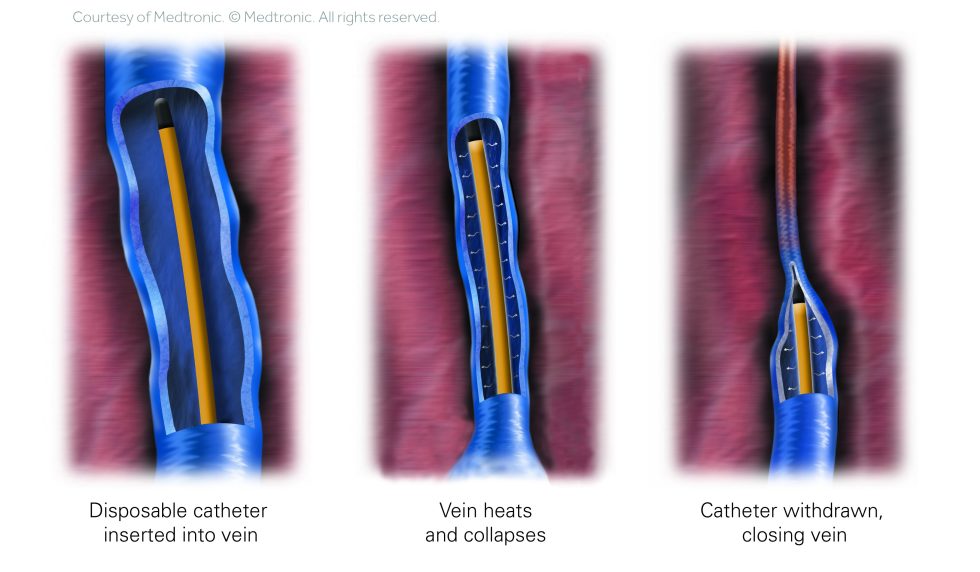
Next, the doctor threads a radiofrequency fiber catheter into your varicosed vein. When the fiber is in place, your provider turns on the radiofrequency energy and slowly moves the fiber through your vein.
As your provider moves the radiofrequency fiber through your vein, the heat closes and seals it. When your varicose vein is closed, your provider turns off the energy and removes the fiber catheter and sheath.
No stitches are required and a simply bandage at the insertion site is all that is needed. Finally, a pressure bandaged is applied or compression stocking, which helps your treated vein stay closed while also promoting healthy circulation.
How should I take care of my legs after endovenous
radiofrequency ablation?
After your endovenous radiofrequency ablation treatment, you need to wear compression stockings continuously for several weeks. You also need to walk around for 30-40 minutes every day, including the day of your treatment.
You might have some mild bruising or redness around your incision site or the treated vein. Any discoloration should go away within a couple of days. Your varicose vein will drain, shrink, and fade away over the next few weeks.
If you’re troubled by varicose veins and want to find out if endovenous radiofrequency ablation is right for you, call Advanced Vascular today.
Your physician will perform the ClosureFast procedure. Using ultrasound, your physician will position a catheter in the diseased vein through a small opening in the skin. The small catheter delivers heat to the vein wall, causing it to shrink and seal the vein. Once the diseased vein is closed, blood will reroute itself to other healthy veins. Following the procedure, your physician will apply a simple bandage over the insertion site, and may give you compression stockings to aid the healing process. Your physician may encourage you to walk, and to refrain from extended standing and strenuous activities for a period of time. The average patient typically resumes normal activities in a few days.
Learn More About Radiofrequency Ablation
How It Works
Radiofrequency ablation uses heat to close problem veins, redirecting blood flow to healthier veins. This minimally invasive procedure ensures quick recovery and effective results.
- Relief of symptoms with a noticeable improvement
- Tiny Entry Point: A small opening is made in the skin, usually near the affected vein.
- Inserting the Catheter: A very thin, flexible tube (called a catheter) is gently guided into the vein.
- Targeting the Problem Vein: The catheter is carefully positioned along the damaged or varicose vein.
- Applying Gentle Heat: The catheter sends out radiofrequency energy, which heats the vein walls.
- Sealing the Vein: The heat causes the vein to collapse and seal shut.
- Catheter Removal: The catheter is then removed, No stitches are needed.
- Natural Healing: The closed vein is gradually absorbed by your body over time.
- Blood Flow is Rerouted: Your blood naturally finds its way through nearby healthy veins, improving circulation.
Benefits
Experience reduced pain, improved circulation, and a quick return to daily activities. Radiofrequency Ablation is a safe and effective treatment for varicose veins with minimal downtime.
- Minimally Invasive: Radiofrequency Ablation uses a tiny catheter and a small skin puncture—no large incisions or stitches.
- Quick Recovery Time: Most patients return to normal activities within a day or two.
- Effective Results: Radiofrequency Ablation is highly successful in closing problematic veins and relieving symptoms like pain, swelling, and heaviness.
- Less Pain & Bruising: Compared to traditional vein surgery, Radiofrequency Ablation typically causes less discomfort and fewer side effects.
- Fast Procedure: The treatment usually takes less than an hour and is done in-office or outpatient settings.
- No General Anesthesia Needed: Local anesthesia is used, reducing risks and allowing a quicker recovery.
- Improved Leg Appearance & Comfort: Helps reduce visible varicose veins and improves overall leg health and comfort.
- Long-Term Relief: Many patients experience long-lasting symptom relief and improved quality of life.
What to Expect
The procedure is performed in a comfortable outpatient setting. Most patients report little to no discomfort and can resume normal activities within a day.
- Before the Procedure
- Initial Consultation: Your provider will assess your vein health and may perform an ultrasound to map out the problem veins.
- Pre-Procedure Instructions: You may be asked to avoid certain medications, wear loose-fitting clothing, and drink plenty of water.
- During the Procedure
- Quick & Comfortable: The procedure typically takes 30–45 minutes.
- Minimal Discomfort: Our goal is to keep you as comfortable as possible during this
minimally invasive procedure - Tiny Incision: A thin catheter is gently inserted into the vein through a small puncture in the skin—no stitches required.
- After the Procedure
- Immediate Walking Encouraged: You will be asked to walk right after—it helps with circulation and healing.
- Compression Stockings: You may be advised to wear them for a few days to aid healing and reduce swelling.
- Minimal Downtime: Most patients return to work and normal activities the next day.
Frequently Asked Questions
What is Radiofrequency Ablation (Radiofrequency Ablation)?
Radiofrequency Ablation (RFA) is a minimally invasive procedure used to treat varicose veins caused by chronic venous insufficiency. It uses radiofrequency energy (heat) to close off malfunctioning veins, allowing healthy veins to take over blood flow.
How long does the procedure take?
The procedure typically takes less than an hour and is performed in an outpatient setting.
How does Radiofrequency Ablation work?
A thin catheter is inserted into the affected vein under ultrasound guidance. The catheter delivers radiofrequency energy to heat the vein wall, causing it to collapse, seal shut, and eventually be absorbed by the body.
What conditions can Radiofrequency Ablation treat?
- Varicose veins
- Chronic Venous Insufficiency (CVI)
- Symptoms like leg pain, swelling, heaviness, or skin changes due to poor venous circulation
What is the recovery like?
- Most patients return to normal activities within 24–48 hours
- You’ll be asked to wear compression stockings for 1–2 weeks
- Walking is encouraged immediately after the procedure
WHAT OUR PATIENS
have to say
Advance Vascular always appreciates feedback from our valued patients. To date, we’re thrilled to have collective reviews with an average rating of 5 out of 5 stars. Please read what others are saying about Advance Vascular below, and as always, we would love to collect your feedback.
Monica Laycock
I just wanted to say how amazing Dr Banerjee and his team. Debbie, Chris, And Marla are so nice they all take the time to explain everything that is going on. Thetreatment that I’m getting done on my legs is outstanding I’m very happy that I came here I would recommend everybody to come to them. You will feel and see the difference. Oh yeah and I don’t want to leave the ladies at the front desk out you all are so kind all of you keep up the good work
Sonia Dhindsa
I recently visited Dr Banerjee’s office for vascular treatment, and I couldn’t be happier with the results. The Dr performed a vein ablation procedure and it was life changing
It significantly reduced my leg pain! The Entire experience was exceptional! Dr Banerjee and his whole staff is incredibly professional the process. The facility itself was spotless and modern, creating an atmosphere that put me at ease. If you’re looking for a vascular specialist who truly knows what they’re
doing and a team who genuinely cares, I highly recommend Dr Banerjee. I’m so grateful for the cares, I highly recommend Dr Banerjee. I’m so grateful for the care I receive and the relief I now feel! Thank you Dr Banerjee and team!
Martha Doster
Just finished the 2nd of several weekly procedures to alleviate venous reflux. I had no idea what to expect, even though the staff was helpful and informative setting it up. Now, I feel relaxed and not worried at all because everyone involved has been efficient and casually friendly, which puts me at ease. I am grateful to them, and can highly recommend this team.